Tag Archives: coronavirus

THE CHANGING DIMENSIONS OF SOCIAL MEDIA AND IT’S COPYRIGHT ISSUES

by Sidhanta Sarkar

In recent times, the swift and large scale penetration of the Internet has been a matter of concern for policymakers almost as much as it has been a cause for celebration for the users. Social Media has revolutionized the way people meet, interact and communicate in the virtual world but this revolution has not been without consequence. Questions about the protection of intellectual property rights in the virtual world are steadily surfacing in academic circles. Drawing from this background, this note focuses on nexus between the rights of the copyright owner under the Indian Copyright Act and the seemingly innocuous Terms of Use of social media websites that host user-generated content. It also discusses the defenses to copyright infringement in the context of social media as interpreted by the courts. The note also observes that governments are beginning to look upon this area with interest and progresses to identify some of the more recent tools developed to address copyright issues on social media websites. 

Finally, to conclude the note by succinctly summarizing the observations and makes recommendations for the way forward:

Social media has begun to make its presence felt in our lives in a myriad of ways which we could not have envisaged less than a decade ago. We certainly had our means of access to information revolutionized by digital technologies some years ago but it continued to be a one-way street; we acted only as “consumers of culture”. Suddenly, the Internet is becoming a lot more interactive. Users have graduated from an erstwhile ‘ordinary’ lifestyle of merely reading books and going to the movies to a daily routine of actively participating and engaging on social media platforms — Facebook, Twitter, Pinterest, Flickr, Instagram, YouTube to name just a few. Those consumers have now transformed into users that generate culture; for whom words like ‘commenting’, ‘liking’, ‘uploading’ and ‘posting’ are now an inseparable part of their common language. Clearly, it is changing how we perceive the Web and for copyright law, in particular, presents unprecedented questions and challenges.

 In a recent copyright infringement lawsuit, a Manhattan jury found that Agence FrancePresse (AFP) and the Washington Post infringed upon the copyright of photojournalist Daniel Morel by using pictures that he had taken in the aftermath of the Haiti earthquake in 2014 . Curiously, these pictures had been uploaded by Mr. Morel on his Twitter account. AFP had argued that that once the pictures appeared on Twitter, they were freely available as a part of the public domain. However, it is quite heartening to see that some websites have begun to include the implications of the license terms in simple English along with the accompanying legalese to help users understand what they are agreeing to.

Strangely, despite overboard license terms and large scale infringement over social media, cases that have gone to court still remain almost negligible in number. But considering the uncertainties associated with the Fair Dealing doctrine, it is nevertheless advisable for users to be careful in determining whether the material they are sharing or linking to is copyrighted. Memberships of social media websites continue to grow every day and organizations across the world are making efforts to devise models that can help reduce the copyright implications on social media. But the law cannot lag behind for too long. This transformation of the culture of the web is something the Legislature can no longer ignore. It is time for the legislative process to adapt, evolve and do something about it.
ARE YOU A FOLLOWER OF HINDUTVA?

by Aditi Narain

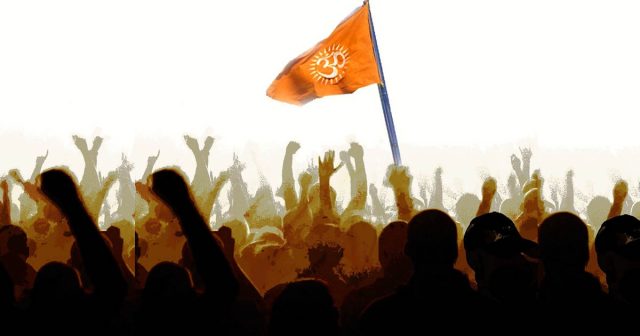
The world is now witnessing the chaos between various parties who are divided on religious bias stand against each other and put the capital of India under threat from unpredictable raging out of masses set out on the roads to trouble the citizens and put up new demands in front of the government in the name of their religious divinity being the most superior.

The term Hindutva is well heard of by every Indian more than once in their lifetime. More or less the current government is driven by the ideologies of a Hindutva imperative. Under the tag of Hindu Nationalism, the government parties they are unaccounted for goons are out on the roads to cut down and violate anyone who supports the other people, referring to the Islamic population. The concept and perseverance of ‘Hindutva’ is well laid down by Sumanta Banerjee, as she recalls the Unlawful Activities(Prevention) Act, drafted in 1967 by the government to abort all discriminatory actions which promote or attempts to promote on grounds of race, religion, caste or communities or any other reason whatsoever, which in turn brings in feeling of hatred between two ethnic or languages based communities. But when the government when was to enact this document, the scope of the legislature was only restricted to secessionist activities. Although the same draft was bought up during the conference of chief ministers of the states in May 1968, again no attempt was made to extend the scope of the legislation to communal activities.

The flow of events eventually led to political parties like BJP, VSS, Shiv Sena, RSS and their leaders who make and derive their metaphors from the old holy books of Hindu mythology. Use the feeble minds of the majorities to lay the groundwork as to how Lord Rama and Lord Krishna had said in these and how they should follow their will and teachings and lead the world. The same Hindu ideology is used to ignite the hatred towards the Muslim communities and treat them as unequal and bad elements of our society. These leaders make the simple people redirect their minds or whitewash them as per their need to move the masses to spread the sense of India being a nation of Hindus and Hindus only. They intend to state that others are all outsiders and were never meant to be on the Indian soil. They push the bull-headed population to believe that the Muslim community will corrupt our kids, take away our jobs and try to snatch away all our liberties from us. Sheer manipulation of all sorts is done by these religious political parties to drive everyone in their mirage of hatred towards the Muslim community.  

In October 2019, an assistant professor Audery, from Rutgers, U.S. attended a rally outside the United Nations where our Prime Minister Narendra Modi was scheduled to speak. She openly criticized the BJP for adhering to Hindutva. She compared Hindutva to Nazism. She said that as the Jews in Germany were treated by Nazis, so is done by Hindutva followers to deal with India’s Muslim community. People highly criticized her by stating all sorts of unproven tails, saying she was anti-Hindu and supporter of Pakistanis, an online petition was raised by numerous people to have her investigated by the university she works for. But Rutgers stood with the professor’s statement stating that she always welcomes a platform to learn through a reasonable debate on the cultural and intellectual history of early-modern and modern India.

Now, where do you think your ideas stand or where do you think Indian’s ideas stand?

DELIBERATION ON NEW EDUCATION POLICY, 2019

by Sidhanta Sarkar

There have been enormous loopholes in the DNEP, 2019 and one such is the inclusion of norms for religious morality. In recent times, this has been the most heated topic of all time. The opposition parties are claiming that DNEP has made things worse for the religious minorities. The contention from opposite parties is clear and transparent that the DNEP has focused only on “Hindutva”.

In section 6.1 of DNEP, it talked of religious minorities and in that, they only talked about reading Panchatantra and Jataka Tales but there has been mentioning of Arabian Nights and other good fables. Also, removing “The Great Akbar” story from the textbook is one such example that the Party does not want to mention any Muslim or other religious minority community.

In the preamble of DNEP, the “Secular” word is missing. This clearly states what the government intends to do. Also, from the case of “T.N. PAI v. UOI”, the Hon’ble court gave the decision that minorities cannot be decided based on religion. Hence, the ruling government is not taking judiciary into consideration which clearly means that slowly, the country is losing its foundation democracy. There has been no mentioning of how the government will deal with disabled people in terms of education. 

Education comes under the concurrent list which means that both the state as well as the central government has equal say. But by making Narendra Modi the head of RJC committee, they have violated the meaning of the concurrent list. 

Below mentioned are some of the recommendations of DNEP, 2019-

  • Inclusion of LGBT community in the gambit of NEP.
  • Amendment to Section 12© of RTE act. 
  • Inclusion of Right of persons with disability Act, 2016
  • Keeping religion and politics away and include secularism.
  • Follow the concurrent list in better and goo spirit. 
  • Education system should be away from privatization and centralization.
  • Fee structure should be regulated.
  • Annual survey regarding absorption capacity for the professional courses.

It is the dire need for the government to take into considerations, all these recommendations mentioned above because it is a very well-settled principle that in a policy, there cannot be such big loopholes and there should not be the inclusion of religion.

ERAS OF POLITICAL DRIFT

By Sidhanta & Aditi

Recently, the global world has started experiencing some revolutionary political changes. As during the twentieth century, realism and idealism both collided as conceptual rivals for understanding international relations, but the situation kept worsening in this scenario. Throughout history, the maps of nations have changed on account of the existence of various political influentials whether it is through democracy or a fascist dictatorship or a Parliament or a Communist dictatorship. The collision has been considered as a loophole in international relations. In a society with a high plurality, people may have all kinds of belief which can vary from person to person.
Changes in the society have led to the variation over time in patterns of political roles. Today, democracy has changed the mindset of society and the growth in competition in politics has become the major problem.
Therein media has emerged as the essential part of the subject as it plays the game of manipulating the society as we have seen in Spanish-American War and Nigeria propaganda War. The Nazis and Americans
portrayed the best of propagandist war. Nazi Germany introduced the term, “Blitzkrieg” and the American version of a blitzkrieg attack was “shock and awe”. Both actions aimed at achieving mass destruction within enemy’s territory. Such annihilation resulted in the violence of inequality and injustice, that is structural violence which as stated by Winter and Leighton, “embedded in ubiquitous social structures [and]
normalized by stable institutions and regular experience”.
Activists agree that the society needs to reconcile, per say, the three paradox of democracy are the parameters for society and its newly flourishing regulations to be kept within the boundaries of democratic
freedom.